


Public recognition for local women in Boroondara


A few months ago, I finally, finally finished transcribing The Gardiners of Gardiners Creek. The entire transcript is a mess of mis-spellings and strange voice recognition translations but the general gist of it can be surmised as simply: Mary Gardiner lived a very sad and tragic life.
To honour this woman and her place in Boroondara’s history, I translated her story into an e-publication called “Mary Gardiner: The Reluctant Pioneer of Boroondara".
You can download it above if you’re interested (its in the library too) and I’ll be using parts of it in my book on Glen Iris.
Purely by coincidence, I recently discovered that in February and March, the Royal Historical Society of Victoria is running a project called “Reclaim Her Name” in collaboration with Gender Equity Victoria’s “Put Her Name on It” initiative. It is designed to help historical societies and history enthusiasts research and advocate for memoralising women in their area. When it comes to honouring the hugely important role of women in Victoria, there’s more likely to be a monument/memorial/street named for a man advocating for women than for the woman herself.
Think of how ubiquitous the Gardiner name is in Boroondara when he only lived here for three years. And we all know nothing was named because of Mary – the Gardiner who cared about being a settler and stayed in Melbourne until her death.
So, in honour of this important initiative from RHSV, I have decided to investigate just how many places and locations are named for women in Boroondara.
Comments are open so if you know somewhere I’ve missed, I would LOVE to hear about it.
Let’s dissect what AI has to say
A historian’s job in 2026 is essentially disputing the AI slop that the internet serves up about history. Since most people will turn to the internet for the answer to the question “what is named after women in Boroondara” I thought I would ask it. Brace yourself (American spelling is theirs):
Dorothy Laver Reserve East (Kew): A park and playground, likely named to honor a local woman.

Yikes. First of all, the East and West Dorothy Laver Reserves are nowhere near Kew but in Glen Iris and Ashburton respectively. There’s a playground but the reserves themselves are primarily used as sporting fields. Dorothy Laver OAM, who lived in Glen Iris (not Kew) was not just any old ‘local woman’. She was the first woman elected to the ultra-conservative City of Camberwell Council (also not in Kew) in 1983. After the Freeway went in, Mrs Laver advocated for converting those long-standing scrappy paddocks (that were not in Kew) into sporting fields for less renowned local sports, like lacrosse (that they didn't play in Kew). You can read more about her in my post about Ashburton’s Green Spaces.
Aunty Dot Peters AM Flowering Grasslands (Swinburne University, Hawthorn): Located on the Hawthorn campus, this space is named after respected Yarra Yarra Elder Aunty Dot Peters AM, a prominent Indigenous figure.
This is far more accurate. That is because it comes from the Swinburne University website and AI bots tend to think University websites are credible sources of authentic information. Aunty Dot did a huge amount of work progressing reconciliation in Victoria, including with Swinburne University, so it is very generalised to call her a ‘prominent Indigenous figure’ but at least it did not think she was in Kew.
Lewin Reserve (Glen Iris): While named for a family, this reserve features the upgraded Lewin Reserve Pavilion.
WTF does that mean? Are they trying to say “Oh. Ah well, there was probably a woman in the Lewin family so it totally counts. Hey, look – a cool new pavilion!” At least it is actually IN Glen Iris. [eyeroll]
The reserve was probably named after John Nutter Lewin, a City of Hawthorn Councillor in 1990 who lived on KooyongKoot Road.
Wominjeka Garden (Swinburne University, Hawthorn): A space in the campus's gardens that honors Indigenous women and culture.
Murnong Gallery (Swinburne University, Hawthorn): A gallery on the Hawthorn campus that showcases Indigenous culture.
Wominjeka means ‘Welcome, what are your intentions?’ in the Wurundjeri-Woiwurrung language. As far as I can see from the Swinburne University map, there are places recognising indigenous culture but no place there called Wominjeka Garden, nor one honouring indigenous women and culture aside from Aunty Dot’s grassland.
Ditto on the Murnong Gallery. They may mean the Murnong First Peoples Gathering Place (IN GLEN IRIS!) and it came up because murnong translates to “yam daisy” and Daisy is a traditional girls name. Maybe? Who knows.
Places Named in Historical Context (Camberwell/Hawthorn): The Hawthorn Historical Society often highlights local women, such as the 8 influential women recently featured in a "Women of Influence" exhibition.
This is progress! However, that exhibition is not starting until March 2026 and the website does not name the women but it is a positive sign. Shoulda been higher, as they say.
I would not say Hawthorn Historical Society ‘often’ highlights women but it does have a fair crack at it. A trawl of Hawthorn Historical Society’s newsletters reveals:
Alathea Noel Grant, an intelligence officer, parachuted into Paris during WWII and awarded Chevalier de la Legion D’Honneur by the French Government. The Noel Grant trophy at the MCC Croquet Club is named after her.
Nancy Weir was an accomplished concert pianist.
Dame Nellie Melba, Australia’s first internationally recognised opera singer, who was born in Burnley, but “not far from the Burnley/Hawthorn boundary”. When she was not performing overseas, she spent most of her time in the Yarra Valley, so it is perhaps pushing it a bit claiming her for Hawthorn!
Jane Laidley Nathan, a Hawthorn City Councillor and one of Boroondara’s 150 significant people in the past 150 years. (For the record: I can't find much on this list so I have my friends at the Local History Office looking into it for me)

Jane Nathan (centre) is now President of the Grace Park Lawn Tennis Club, courtesy of Tennis Victoria
So yeah, Hawthorn Historical Society do sometimes talk about women in their newsletters to members. But the information is buried in PDF documents that are not formatted in a way that makes them indexable by Google.
This is a real problem. You can upload all the documents and information you like about people that should be recognised but if no-one can find it, it's not that useful now is it?
For example, I searched for Mary Ann Henty, who was an early settler living in Kew. The Kew Historical Society has an interesting article about their efforts to conserve her wedding dress in their June 2025 newsletter. But if you Google ‘Mary Ann Henty’, this article does not come up in the search results for her name.
Henrietta Dugdale's Legacy (Camberwell): While a street might not bear her name, the area around Riversdale Road, Camberwell, is significant for being the home of Henrietta Augusta Dugdale, a pioneering campaigner for women's suffrage.
The Camberwell Historical Society website has a short article about Henrietta Dugdale and her accomplishments but does not mention a connection to Riversdale Road, only that she lived in Camberwell. It is true there is not a street named after her in the area, only one in Cook, ACT.
I imagine the conservative men of early 20th century Camberwell considered a woman agitating for change to be the absolute last person they would seek to recognise.
Additionally, the Boroondara Council has historically recognized women in local government, with 53 women serving as Councillors and 17 as Mayors across the former cities of Camberwell, Hawthorn, and Kew.
This information refers to the 2020 exhibition, Tracing her steps: women in Boroondara local government and so do those numbers. But those three Councils were over a CENTURY old before they merged into Boroondara Council in 1994. Seventeen mayors serving 2-3 year terms is not that many. Without telling you how many male Councillors there were by comparison you only get half of the story here.
For the record, I can tell you of the 17 mayors on Boroondara Council since 1996 (some of them had a go a couple of times) seven were women with four deputy-mayors, including the current one. Boroondara Council has had 49 councillors with 15 women (31 per cent).
This means if you’re a woman and win a seat on Council, there’s a fair chance you can have a spin at being mayor or deputy.
OK – now we have established that the information AI gives you on “things named after women in Boroondara” is at best, scant and at worst, completely wrong, what has REALLY been named for local women in Boroondara?
Turns out, not a lot.
Reserves named for women
Boroondara has 58 Council-owned reserves. The vast majority were created before World War II at a time when it did not occur to male councillors to name things after women, especially sporting fields for sports they were not allowed to play. Arguably the only reason for Dorothy Laver to get a reserve named for her was because it was created after the joining of the Freeways in the 1980s. No way were they going to rename one in her honour.

It is a source of some frustration to me that the Council’s website does not provide any information on how its reserves acquired their names. This would go a long way to helping AI learn local history.
Some reserves are obviously named for the suburb: Ashburton Park, Balwyn Park, Camberwell Sportsground; others are obviously named after a man, usually a long-term city councillor: Eric Raven Reserve, H A Smith Reserve, Howard Dawson Reserve. A couple bear traditionally female names but this does not mean they were named after a woman of local recognition. Myrtle Park was probably named for the vegetation in the Balwyn area; while Grace Park was named after the Grace Park Estate owned by Michael and Lydia Lynch who it seems, just liked the name Grace Park.
Of course, there’s always Alexandra Gardens, named after Alexandra of Denmark who reigned as Queen Consort in 1910 when Kew Council created the reserve. Then there’s Victoria Park and Victoria Road Reserve but they hardly signal a local touch now do they?
According to Gender Equity Victoria, the statistics on place naming in Victoria are that 1 in 5 places are named for a person; and 1 in 10 of these are named for a woman (including Queen Victoria). In Boroondara, 40 per cent of its reserves are named for local men. Around 24 per cent have a generic name, like “Fairview”; 26 per cent are named after a place; and a scant 10 per cent are named for women, with only ONE of these a local woman: Dorothy Laver.
Indoor spaces named for women
Indoor spaces named for women fair a little better but often they were not local women.

The Phyllis Hore Room at Kew Library is named for long-running Kew Councillor, Phyllis Hore. She made several attempts to sit on Council, eventually succeeding in 1972 and stayed until her death in 1994.
Also at Kew Library is a plaque honouring Janet Gertrude “Nettie” Palmer (1885-1964), an accomplished poet, essayist, biographer, and Australia's leading literary critic of her day. It appears when not overseas Nettie lived mostly in Emerald but perhaps there was a Kew connection.
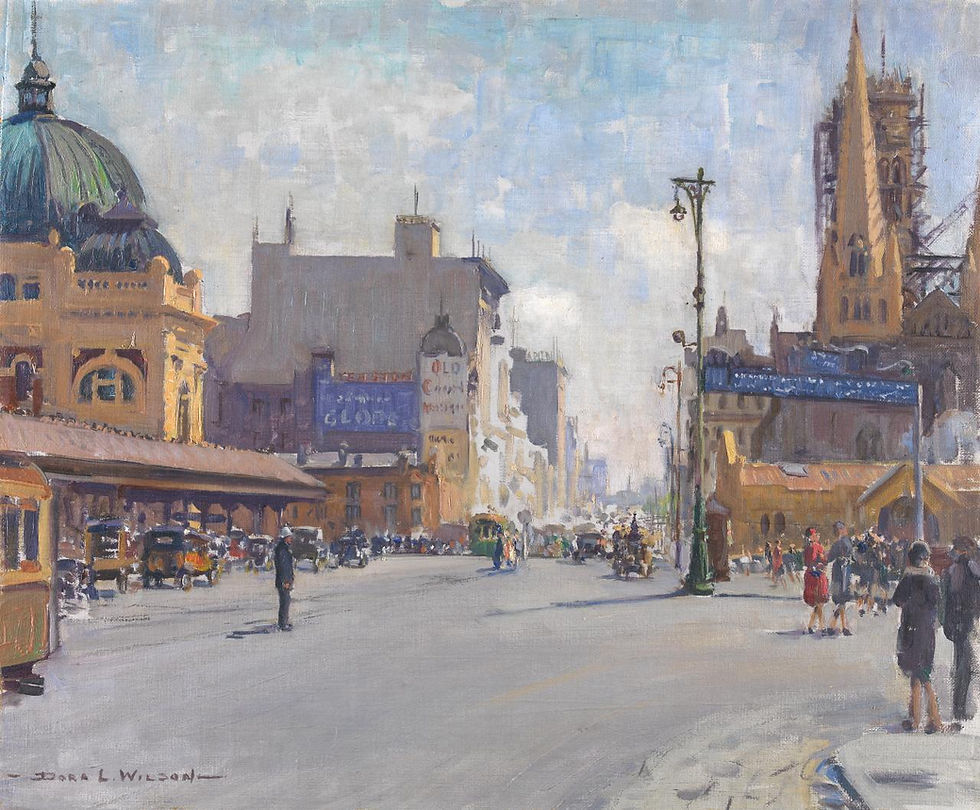
The Hawthorn Arts Centre has the Dora Wilson room, named for the commercially successful artist famed for etchings, pastels and oils of still life, Melbourne street scenes, nudes and portraits (especially of children). Also, not sure if there is a Hawthorn connection there, maybe she produced an artwork of it.
The Ashburton Community Centre has the Copland Room. Although carrying her husband’s family name, it is well-known among older Ashburton residents that Luba Copland wore the pants in that relationship. She was known as “Mrs Ashburton”, heavily involved in advocating for the Ashburton Library (and local libraries in general) and the Community Centre.
In a similar vein, the Foard Williams Room at Greythorn Community Hub carries the name of Gwenda and Graham Foard, long-time community advocates in North Balwyn recognised with Australia Day Honours in 2022.
Most of the Community Centre room names are generic “meeting room 1” types and given women are heavily involved in their creation and ongoing survival, there’s potential there to name them for local women. Probably after they're dead. Sigh.
Street art featuring women

Frustratingly, there is no list of the diverse array of street art in Boroondara anywhere beyond those projects sponsored by the Council. The area does like a good steam train mural but there is only one with an actually local women that I can identify; milliner Susannah Sarovich in Surrey Hills (pictured above). Happy to be proven wrong on that one.

Women do feature on some of the street art in the area, including:
In the Greythorn Icons, a series of five wooden sculptures on Doncaster Road, opposite Fire Station #19
They love their sculptures up in Greythorn where there are three women in the Faces of Greythorn sculptures at Greythorn Shopping Centre
The “beautiful [young white] woman” on Open Windows, Glenferrie Road, Hawthorn
Caricatured women playing sport at Grace Park, Hawthorn
There’s a woman on the mural at Anderson Park in Hawthorn. There’s also a platypus and a duck.

A woman’s eyes are on the south side of the High Street bridge mural in Ashburton
A stick figure of a female WWII nurse also features on a power box on High Street

"Mayoress" of Camberwell Library The 1982 bronze “Mayoress” statue stands in the grounds around Camberwell Library to honour the mayoresses (mayoressi?) of Boroondara. According to the Oxford English Dictionary, the term ‘mayoress’ does still mean ‘wives of mayors’ AND ‘female mayors’. But I think this statue is for the ‘wives of mayors’.
There’s been seven mayoressi in Boroondara since 1994 and we don’t call their husbands/partners the ‘mayor’ now do we?
There is possibly a woman on the 55m Hartwell mural but it is a bit tricky to tell (kids did it)
There is a woman on the ACER mural near Camberwell Station
There’s also the pink-haired Lady of Larelle Lane at 1 Prospect Hill Road, Camberwell
There’s a big-eyed blonde girl on the mural outside the Old Garage Café in Camberwell

Progress being made
Nowhere will AI tell you about Boroondara’s most famous living alumni: Kylie and Dannii Minogue. Fortunately, they are frequently honoured; in 2024 by Rotary Camberwell Sunday Market with “Kylie and Dannii Day” at Camberwell Junction and this year in Kylie and Dannii Disco in the Park on 6 February 2026.
How cool would a Kylie and Dannii Mural be?
Trailblazing mechanic Alice Anderson founded the first all-female garage in Kew. A fundraising drive to create a life-size bronze statue of Alice to be installed in Petrie Street, near the location of her garage, is currently underway. To donate, visit the Alice Anderson Memorial Project website.
Do you have a suggestion for inclusion in the list?
Let me know in the comments!
Further reading: The list of women included in 2004's most prominent 150 Boroondara residents


This is a very helpful compilation and I'm very pleased to see you mention The Alice Anderson Public Art Project which will see a bronze statue of Alice Anderson erected in Petrie Square, Kew in mid 2027 (the first statue of a named women in Boroondara). Would you have suggestions on local notable Surrey Hills women that the new open space outside Union Station in Surrey Hills could be named after (besides Kylie Minogue)? This survey is open until 4 November 2026: https://yoursay.boroondara.vic.gov.au/surrey-hills-open-space-name